
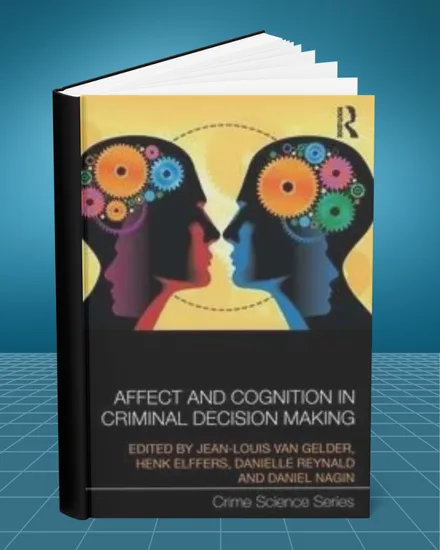
 1st editionPDF
Affect and Cognition in Criminal Decision Making 1st edition (first edition)
- Format
- Searchable PDF
- Version
- Digital enhanced version
- Delivery
- Instant access
$29.90 USD
Buy PDF ↗Before you buy
This is an eBook/PDF product only. No physical book will be shipped.
Please confirm the book title and edition before completing your purchase.
Your PDF download link will be sent to the email address used at checkout, immediately.
About this book
Affect and Cognition in Criminal Decision Making 1st edition by Jean-Louis van Gelder, Henk Elffers, Daniel S. Nagin, and Danielle Reynald examines how emotions, moods, impulses, and cognitive processes shape decisions to commit crime. The book challenges purely rational models of offending by showing how affective states can interact with perceived risks, anticipated rewards, self-control, and situational pressures during criminal decision making.
The book covers rational choice perspectives, affect and emotion in offending, fear, anger, shame, anticipated emotions, immediate affect, sexual arousal, drug craving, self-conscious emotions, and neuropsychological influences on criminal choices. Empirical chapters examine offenses including robbery, pilfering, unethical behavior, and sexual offending, using interviews, observations, experiments, questionnaires, and other methods to investigate how emotions influence decisions before, during, and after criminal acts.
This book is especially useful for Criminology Students, Criminal Justice Students, Forensic Psychology Students, Social Psychology Students, Behavioral Science Students, Sociology Students, Judgment and Decision Making Students, Behavioral Economics Students, and graduate students researching offender decision making. It is particularly relevant for coursework and research involving rational choice theory, situational crime, self-control, emotional processes, and the psychology of offending.
Criminology students, forensic psychology students, criminal justice researchers, behavioral scientists, sociologists, and graduate trainees can use this edition to compare cognitive and affective explanations of offending, evaluate empirical studies of criminal choice, and examine how emotion changes risk assessment and behavior in specific crime situations. The complete 1st edition is available as a searchable PDF enhanced digital version with instant access, so you can begin using it immediately for criminology coursework, research projects, thesis preparation, seminar discussion, or advanced study of criminal decision making.